


At the European level, the Renewable Energy Directive (RED II) has regulated and provided a tool for European citizens to create innovative social models [1]. As emphasized in the Directive, Energy Communities (ECs) produce added value in terms of "acceptance of renewable energies” and stimulate investments on the ground: the overall contribution of these initiatives is demonstrated by their active participation in the ecological transition process [2]. As part of the European Union's (EU) strategy, the Commission realized the value of ECs for the achievement of national targets: it was therefore decided to support them by establishing a favorable regulatory framework, as specified in Recital 70 of RED II. The Directive provided definitions, rights and obligations for Renewable Energy Communities (RECs) and required EU Member States to create frameworks for their development [3]. In particular, the definitions of collective self-consumption and RECs were detailed in Articles 21 and 22, respectively. The latter stipulated that RECs have the right to "produce, consume, store and sell renewable energy" (subsection 2 letter a) and then "exchange, within the same community, the renewable energy produced". For example, photovoltaic (PV) producers effectively act as dual consumers and producers of electricity, allowing them to not only reduce their energy expenses but also generate additional income by selling surplus energy. These advantages are driving the adoption of prosumership within energy communities and are expected to become more deeply integrated, involving a diverse array of participants.
European countries RECs regulation comparison in [3], the authors provide a graphical overview in Figure 2 that aims to provide an assessment of the degree of maturity of transposition processes evaluating a series of indices provided by RESCoop (REScoop.eu). The development of support schemes for Renewable Energy Communities (RECs) across Europe varies significantly, with Austria, France, and Germany leading in terms of structured policy frameworks. In Austria, RECs are actively considered in the design of eligibility criteria for renewable energy incentives, ensuring that community-led projects can access financial and regulatory support. Similarly, France integrates RECs into its broader energy transition strategy, providing preferential conditions for local energy communities within its support mechanisms. Germany, known for its strong community energy sector, has tailored policies that facilitate REC participation in the energy market by ensuring access to grid infrastructure and financial incentives. Belgium also shows progress, with specific support mechanisms for community-led renewable production. In contrast, other European countries are still in the early stages of REC integration, often lacking targeted measures. This disparity underscores the need for a more coordinated European approach to strengthen the role of RECs in the energy transition. In [4], Fina et al. discuss the difficulties and positive aspects encountered in Austria in the transposition process of the EU Directive and point out that only a multidisciplinary team can effectively help in the drafting of a national regulatory framework for RECs.
Notably, Italy remains the only European country that considers a support scheme where incentives vary based on both the size of the renewable energy installation and the geographical location. This distinctive approach reflects an effort to tailor financial support to local energy conditions, potentially serving as a model for other nations aiming to enhance REC participation in diverse regional contexts.
The literature review for this study focused on summarizing the analytical tools and methods used by different authors for RECs economic optimization and incentive allocation. D’Adamo et al. (2022) employed Net Present Value (NPV) calculations and Break-Even Point (BEP) analysis to assess the economic viability of renewable self-consumer (RSC) policies, recommending strategies to foster RSC development and resident engagement in energy transitions [5]. Belloni et al. (2024) integrated EnergyPlus with the “EnergyCommunity.jl” tool in a thermal-electric co-simulation approach to optimize RECs design in Italy, demonstrating benefits in self-consumption and energy sharing [6]. Cosic et al. (2021) applied mixed-integer linear programming to RECs planning, showing reductions in energy costs (15%) and CO2 emissions (34%) in an Austrian case study [7]. Di Somma et al. (2024) used stochastic linear programming to optimize shared energy revenues under Italian regulations, increasing revenue by up to 59.7% through rooftop PV, air conditioning, and battery storage strategies [8]. A Multi-Objective Particle Swarm Optimization (MOPSO) algorithm has been leveraged by Faria et al. (2023) to balance cost minimization and energy production in RECs, optimizing metrics like Levelized Cost of Energy (LCOE) and Self-Sufficiency Ratio (SSR) [9]. A multi-agent-based solution was proposed by Faia et al. to minimize the energy cost of a REC including a high penetration of electric vehicles. Fioriti et al. (2021) proposed a game-theoretic framework for RECs aggregators, reducing costs by 16% and enhancing shared consumption by up to 51% [10] while Lazzari et al. (2023) utilized customized Genetic Algorithms for solar energy allocation and participant selection in Spanish RECs, achieving emissions reduction and low payback periods [11]. De Villena et al. introduced a centralized optimization framework for revenue-sharing mechanisms that enhance equity and stability in RECs [12]. Stentati et al. examined the transition from mixed-integer programming to convex optimization to enhance the operational efficiency of Renewable Energy Communities (RECs) under Italy's incentive schemes, with an emphasis on flexibility and equitable benefit distribution. [13], [14]. Weckesser et al. explored similar profit-maximization frameworks, emphasizing scalability and equitable distribution among participants [15]. A fair distribution method was also analyzed by Casalicchio et al. in two different works on RECs defining also a fairness index for incentive distribution [16], [17]. Taromboli et al. analyzed energy-sharing models across Italy and Portugal, ensuring equitable benefits through optimization tools and consumer protection mechanisms [18]. Thanks to the experimental transposition that will be discussed in the following paragraph, Italy was able to attract both research and real-life case studies to the area. Most of the articles based on the Italian regulations took the experimental model as the reference because it is the one that remained in force until the beginning of 2024 [19]. Within this regulatory scheme, Battaglia et al. performed a comparative analysis between three different incentive schemes considering electric vehicles recharge service [20]. Zatti et al. studied an economic distribution mechanism through a Shapley value-based approach [21] while Ghiani et al. showed the real economic income of the first REC born on the Italian territory [22]. Another case study in Caserta (IT) was also evaluated by Barone et al. proposing a Hybrid Neural Network to simulate building demands and estimating 1.6% to 19.5% savings for consumers compared to the reference scenario [23].
Collectively, these studies demonstrated the versatility of advanced tools like TRNSYS, EnergyPlus, Genetic Algorithms, and various optimization techniques and methods in REC planning and operation, emphasizing their economic benefits. All these methods can optimally simulate the energy performance of these configurations but are complex to use when the main aim is to analyze economic performance with reference to a very specific incentive scheme. In addition to being specific to the Italian case, the incentive scheme that will be analyzed in depth in this work has undergone variations over time that have made it even more complex by including additional variables in the calculation.
This study hypothesizes that the transition from experimental to definitive regulatory frameworks for Italian Renewable Energy Communities (RECs) impacts their feasibility and sustainability. It posits that recalibrations in incentive structures may have introduced regional disparities, potentially diminishing the comparative advantage previously held by southern regions under the new decree. By conducting dynamic simulations across diverse scenarios - including variations in plant size, location, and market conditions, as well as extreme cases like pandemic-era energy prices - it explores how these changes affect cash flows and economic performance. Furthermore, the study investigates how the integration of market and technical variables, such as zonal energy prices, solar irradiance, and REC operational models, could reveal critical insights into the feasibility and regional implications of incentive distribution. Finally, it will draw conclusion on policy adjustments that can promote a more balanced and equitable distribution of incentives, advancing Italy's energy transition objectives while ensuring all regions benefit equitably.
In order to enable the reader to better understand the following sections, a brief description of the structure of the Italian grid, the functioning of the electricity market and the main actors involved in it is given below.
The Italian electricity grid is organized into two main systems: the high-voltage transmission grid and the medium-to-low voltage distribution grid. The high-voltage transmission grid operates at voltage levels of 380 kV, 220 kV, and 150 kV and covers long-distance electricity transport across the country. It is managed by Terna, the national Transmission System Operator (TSO), which ensures the efficient flow of electricity and stability of the system. Within this system, primary cabins play a critical role by transforming high voltage into medium voltage (10-30 kV) for regional distribution. The development and maintenance of this grid is overseed by Terna, as outlined in its Grid Development Plan, which includes strategic projects to integrate renewable energy and enhance energy security (Terna - Grid Development Plan).
The medium-to-low voltage distribution grid is responsible for delivering electricity locally. It operates at medium voltage (10-30 kV) for regional networks, which is then reduced to low voltage (230-400 V) for final delivery to end users such as homes, businesses, and small industries. This part of the grid is managed by Distribution System Operators (DSOs), including Enel and other regional providers. Secondary cabins are key components of this system, as they transform medium voltage to low voltage for direct supply to consumers. This structured and hierarchical organization ensures the seamless flow of electricity from generation sources to consumption points while maintaining efficiency and reliability (Terna - Italian Grid Code).
The Italian electricity market is structured to ensure efficiency and competitiveness while integrating renewable energy sources. It operates through several market segments, with the Day-Ahead Market (DAM), playing a crucial role. The DAM allows electricity producers and consumers to submit bids for the next day, facilitating the determination of energy prices based on supply and demand. Italy is divided into several market zones, reflecting geographical constraints and grid congestion, which can lead to price differentiation among regions.
The Energy services Management authority (GSE) plays a pivotal role in promoting and managing incentives for renewable energy producers. The GSE funds these incentives through revenues generated from the sale of electricity on the market and fees collected via the system charges included in consumer electricity bills. The incentives managed by GSE include feed-in tariffs and incentives for self-consumption in Renewable Energy Communities (CERs). The GSE also administers the so-called Ritiro Dedicato (RID) scheme, allowing producers to sell their electricity directly to the GSE at regulated market prices.
The Regulatory Authority for Energy, Networks, and Environment (ARERA) is the regulatory authority overseeing the electricity market to ensure transparency, competition, and consumer protection. ARERA defines the tariffs for electricity distribution and transmission, establishes rules for the integration of renewable energy, and supervises market operations to prevent monopolistic behaviors. Additionally, ARERA sets the criteria for network access and system balancing, ensuring that both traditional and renewable energy producers can operate efficiently within the market. Through its regulatory framework, ARERA fosters a fair and sustainable energy transition aligned with European Union directives.
Together, the DAM, GSE, and ARERA form the backbone of Italy's electricity market, balancing economic efficiency, sustainability, and grid stability while promoting the development of renewable energy sources.
The Ministry of Environment and Energy Security (MASE), with the transposition of European directives in 2020 through Decree Milleproroghe 162/2019, later converted to n. 8/2020 on February 28, 2020, ARERA Resolution 318/2020, and the Ministerial Decree of September 16, 2020 (from the Ministry of Economic Development (MISE)), the regulatory framework and mechanisms for incentivizing Renewables Energy Communities (RECs) were defined.
Since late 2019, the national implementation process of the two EU directives has provided momentum for the development of state support for the Community Energy sector in Italy. As a first step towards national implementation of the EU directive, Article 42-bis of Law 8/2020 provided an experimental formal definition within the Italian regulatory framework, thus initiating the pilot phase.
The requirements and constraints for the establishment of configurations have been defined, specifying that the renewable energy plant serving the community may have a nominal power limit of 200 kWP, and providing a narrow definition of "locality", allowing only members connected to the same low-voltage distribution cabin, also known as a secondary cabin. In August 2020, ARERA defined the support incentive regime. RECs were entitled to a direct incentive for each kWh of self-consumed electricity (110 EUR/MWh) and partial reimbursement of transport tariffs reflecting costs (10 EUR/MWh). The total incentive was defined to amount to 120 EUR/MWh, to be granted only for kWh of electricity consumed simultaneously with production.
Three types of incentives have been determined, which fall within the regulatory framework:
shared electricity feed-in-tariff under the Ministerial Decree DM MASE no.414/2023;
valorization of self-consumed electricity by returning the tariff components as provided for in ARERA Resolution 727/2022/R/eel;
withdrawal of electricity fed into the grid by the GSE.
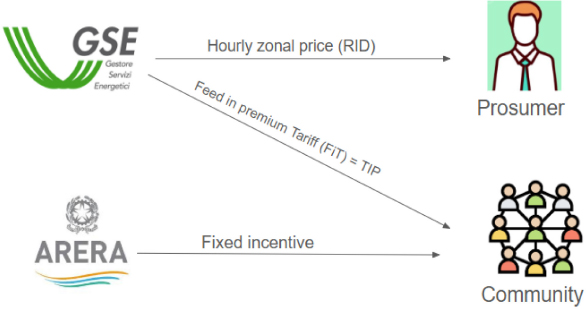
For each kWh of incentivized electricity, the GSE pays, for a period of twenty years, a unit fee, defined as a premium rate. For each kWh of self-consumed electricity, the GSE recognizes, again for a period of twenty years, a unit fee, defined as an enhancement contribution, relating to the transmission tariff. Shared energy is defined as the minimum, in each hourly period, "between the electricity injected for sharing purposes and the electricity withdrawn for sharing purposes". This structured mechanism is meant to incentivize consumer behaviors that maximize local consumption of electricity and minimize export to the grid. Any electricity not self-consumed within the REC is sold to the grid at zonal prices. The incentive flows are visualized in Figure 1.
Incentive flow visualization
Upon initial analysis, it emerged that the regulatory framework introduced by Law 8/2020 was intended by the Italian legislature as a first step towards a more comprehensive and extensive implementation of the EU directive.
With the publication of Legislative Decree 199/2021 [24], there is an update of the criteria related to the configuration of RECs.
With the final regulatory framework thus consolidated, Community Energy Resources fall within the definition of "Distributed Self-Consumption Configurations", which has been based on a virtual model that allows participation even for those who do not have a plant connected to their own supply. The goal is to promote access to renewable energy production for a larger number of users, encouraging investments in the territories. The nominal power for each individual plant included in an energy community was increased from a scale of 200 kWP to 1 MW and the geographical boundaries were also expanded from the secondary cabin to the primary cabin, identified as a requirement for accessing incentives.
In 2023 and 2024, the GSE undertook a comprehensive process to delineate the land coverage and user base of primary cabins within Italy's electricity grid. This initiative, based on data provided by Distribution System Operators (DSOs), aimed to enhance transparency and support the development of energy communities. The process included a period of public consultation, during which feedback was solicited to refine and adjust the boundaries of these areas. The finalized coverage maps and related information are now accessible on the GSE's official website, providing valuable resources for stakeholders involved in energy planning and community initiatives.
To grasp the evolution of the regulatory system from the experimental phase to the final one the regulations on energy communities outlined above are compared in Table 1.
Regulatory frameworks comparison
REC |
Experimental regulatory framework |
Regulatory framework in force |
|---|---|---|
Maximum Size |
200 kW |
1 MW |
Perimeter |
Low-voltage (LV) users, connected to the same secondary distribution substation |
Medium-voltage (MV) users, connected to the same primary distribution substation |
Members |
Individuals, Small and Medium-sized Enterprises (SMEs), local authorities and municipalities |
Individuals, SMEs, local authorities and municipalities, research and training institutions, religious entities, those in the third sector, and environmental protection organizations |
Year of construction |
Plants commissioned after the entry into force of the decree-law 162/19 |
Newly constructed plants subsequent to the date of publication of the Decree. For plants/units that commenced operations before 24/01/2024, documentation signed prior to the commencement date of the plant must be produced, indicating that the plant/unit was built for the purpose of its inclusion in a REC |
Premium Tariff |
110 EUR/MWh |
Varies depending on the size of the Renewable Energy Sources (RES) plant |
ARERA tariff |
Transmission tariff in LV (7,78 EUR/MWh) + Variable component BTAU (0,59 EUR/MWh) |
Transmission tariff in LV (10,57 EUR/MWh) |
In this section, the modeling framework adopted for the policy analysis is introduced. The proposed method is also depicted in Figure 2 to give a better overview of the process.
Method overview
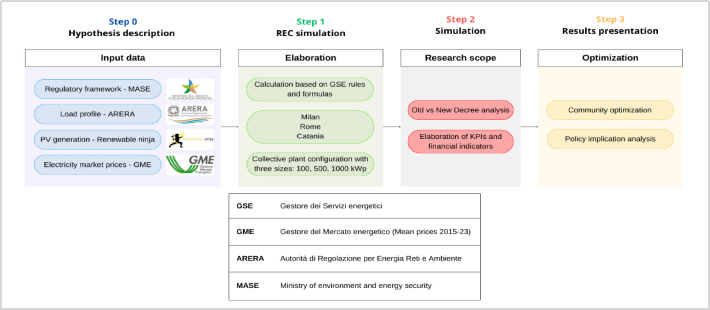
The process began with the collection of key input data, including the regulatory framework from MASE, load profiles from ARERA, PV production simulations from Renewable Ninja, and electricity market prices from the Energy Markets Management authority (GME). All this input data has been further justified in the dedicated chapter. Using this data, the REC simulation was conducted, applying the incentive scheme rules and formulas to model scenarios for three Italian cities (Milan, Rome, Catania) and evaluating collective PV plant configurations of 100, 500, and 1000 kWP. The different locations and sizes were chosen so that all variables in the formula for calculating the incentives would vary. The simulation progresses into the research scope, where an analysis is performed to compare old and new regulatory decrees to assess the feasibility and performance of RECs in both regulatory frameworks. Finally, in the results presentation, the findings are used for community optimization, identifying the best operational strategies, and conducting a policy implication analysis to provide insights for improving future regulations.
The data collection process was conducted using Excel as the primary tool for organizing and analyzing inputs and outputs.
1. Initial Configuration Optimization: the first step involved optimizing the configurations of photovoltaic systems to align with the study's objectives. This included identifying parameters such as plant size, location, and market pricing, ensuring that the selected configurations were realistic and representative of diverse scenarios.
2. Scenario analysis: the objective of the study was to compare cash flow calculations across three scenarios, based on different photovoltaic system sizes: 100 kW, 500 kW, 1 MW. For each scenario, the analysis incorporated data from three distinct macro-regions. Zonal market prices (PZ) for each region were derived from official market data to provide accurate input for financial modeling. After analyzing the scenarios for the three system sizes, the study further evaluated policy implications.
3. Data synthesis and comparison: the collected data was synthesized in Excel, allowing for a clear comparison of cash flows, operating costs, and benefits across different scenarios. This step facilitated the evaluation of both technical and economic aspects of the proposed solutions.
In this section, the sources where datasets for the simulations were extracted, the made assumptions and the established boundaries are presented. To make the discussion clearer, the assumptions made in this model have been broken down as follows:
Mathematical model for incentive calculation;
Geographical variables;
Irradiance and PV production;
Electricity market and zonal prices;
Consumption data.
Given the complexity that has arisen in terms of the incentive calculation, the formulas governing this incentive were included in the final decree [24]. These formulas have been set out below in order to make the variables involved and the constraints imposed clear.
Firstly, the premium tariff has been calculated according to the size of the power plant. There were therefore three different classes, as represented in Table 2. For each of the classes, a formula was defined with which the Reward Incentive Tariff (TIP) was calculated, consisting of a fixed part and one that varies according to the grid sale price of the energy. The variable component is a function of the zonal price increasing when the market price decreases. Finally, a ceiling was imposed on the tariff calculated in this way, varying between 100 and 120 EUR/MWh depending on the size of the community plant.
Feed in Tariff (FiT) calculation
Size |
TIP |
Maximum FiT |
|---|---|---|
PV plant > 600 kW |
60 + max (0; 180 – PZ) |
100 EUR/MWh |
PV plant > 200 kW & ≤600 kW |
70 + max (0; 180 – PZ) |
110 EUR/MWh |
PV plant ≤ 200 kW |
80 + max (0; 180 – PZ) |
120 EUR/MWh |
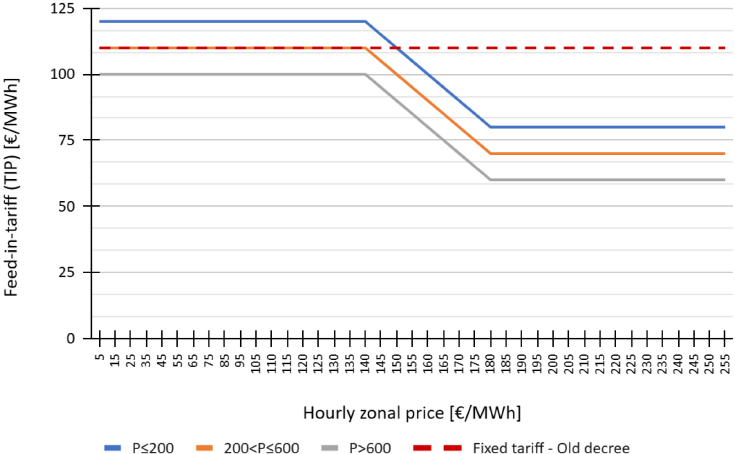
Following the formulas described in Table 2, the (FiT) varies with the zonal price (PZ) as displayed in Figure 3. When compared with the FiT of the experimental regulation (110 EUR/MWh fixed), it can be seen immediately that:
• If the energy selling price remains under 140 EUR/MWh small-size plants (less than 200 kW) are economically advantaged by the final decree. Medium-size plants experience no change in incentive while large-size plants experience a decrease (from 110 to 100 EUR/ MWh;
• If the selling price of energy exceeds 150 EUR/MWh all configurations will see a decreased incentive compared to the experimental case;
• If PZ is between 140 and 150 EUR/MWh, the only configurations that see an increased economic return are those formed by small-scale plants.
Feed in tariff visualization for different plant size
For photovoltaic installations, a correction factor has been also applied to the premium tariff a value of +4 EUR/MWh must be added for the Central Regions and +10 EUR/MWh for Northern Regions as depicted in Table 3. This correction factor was intended to balance the different hours of sunshine that differentiate the various regions of the Italian peninsula.
Correctional coefficient according to REC geographical location.
Location |
Premium |
Unit |
|---|---|---|
North of Italy |
+10 |
EUR/MWh |
Centre of Italy |
+4 |
EUR/MWh |
South of Italy and islands |
+0 |
EUR/MWh |
The entire premium incentive described above was calculated on the basis of the energy shared within the community. The shared energy is being calculated by the following formula:
where are: EACI, h - shared energy [kWh], Enjected,h - injected energy into the grid [kWh], and Eabsorbed,h - absorbed energy from the grid [kWh].
The variable premium tariff is linked to the PZ and therefore calculated on an hourly basis. The equation described its operation as follows:
where are: CAP - maximum premium tariff varies considering the Power peak of the PV plant [EUR/kWp], TPbase = fixed tariff, varies considering the Power peak of the PV plant [EUR/kWp], and FCzonal = zonal price correction factor
Geographical and energy-related variables differ across regions in Italy. These regions were grouped into various market zones, identified by specific codes. An insightful view of regional disparities in solar energy potential and market conditions throughout Italy is provided in Table 4. Understanding the relationship between irradiation levels, market zones, and feed-in tariffs has been crucial for shaping future energy policy decisions, particularly regarding the zonal price balance introduced by the GSE in the latest decree.
Geographical variables to consider in the calculation of self-consumed energy and the incentive tariff
Region |
Irradiance (kWh/sqm) |
Market zone |
FC Zonal (EUR/MWh) |
|---|---|---|---|
Valle D’Aosta Piemonte Liguria Lombardia Trentino-Alto Adige Veneto Friuli-Venezia Giulia Emilia-Romagna Toscana Marche Umbria Lazio Abruzzo Campania Molise Puglia Basilicata Calabria Sicilia Sardegna |
1501,4 1453,4 1499,0 1432,1 1389,2 1423,0 1364,8 1476,5 1547,8 1503,5 1540,2 1630,8 1574,8 1610,0 1566,9 1632,3 1601,9 1676,6 1785,4 1713,0 |
NORD NORD NORD NORD NORD NORD NORD NORD CNORD CNORD CSUD CSUD CSUD CSUD SUD SUD SUD CALA SICI SARD |
+10 +10 +10 +10 +10 +10 +10 +10 +4 +4 +4 +4 +4 +4 +0 +0 +0 +0 +0 +0 |
Solar irradiance across Italy exhibits significant regional variation, with southern areas receiving the highest levels due to factors such as lower latitude, milder climate, and longer daylight hours. In contrast, the northern regions, particularly the Alps and the Po Valley, experience lower solar radiation, especially during the winter months, owing to a combination of geographical factors including latitude, altitude, and climate. Additional local variables, such as weather patterns, altitude, and proximity to coastal areas, further influence the amount of solar radiation received in specific regions.
The data presented in Table 4 represents the average annual solar irradiance (Global Horizontal Irradiance (GHI)) from 2006 to 2022, as provided by the Department of Energy Technologies and Renewable Sources of the National Agency for New Technologies, Energy and Sustainable Economic Development (ENEA). These data were derived using meteorological stations and simulation models.
Regions such as Sicily, Sardinia, and Calabria exhibit notably higher solar irradiance compared to other Italian regions, with Sicily being the standout. The patterns observed in the data reflect how the zonal price variable introduced by the GSE aligns with increased solar radiation, which varies according to latitude. On average, Sicily benefits from higher levels of solar irradiance, a result of its lower altitude, mild climate, and reduced pollution levels. These factors contribute to a more stable irradiation profile, with lower seasonal variation and reduced cloud cover, compared to the northern regions of Italy. Sicily receives between 4.5 and 5.5 kWh/m²/day of solar radiation, with summer peaks reaching up to 6.0 kWh/m²/day, while northern regions typically receive 3.5 to 4.5 kWh/m²/day. In regions characterized by heavy cloud cover or air pollution, these values can be further reduced.
It was important to note that using regional averages introduced a margin of error of considerable weight, particularly in areas where local conditions vary significantly. Any analysis that wants to go in further in granularity has to take this into account. While ENEA provides more granular data at the provincial level, reducing this margin of error does not eliminate it entirely. However, the regional averages offer valuable insights into how the North-Central-South division in the zonal price variable benefits some regions more than others. For example, the average annual irradiation in Liguria is very similar to that of Marche and slightly lower than that of Molise, despite the additional +10 EUR/MWh incentive offered to regions in the south.
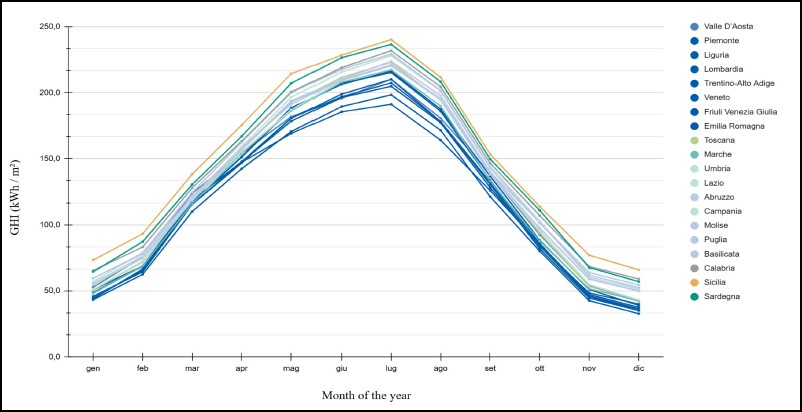
When examining solar irradiance on a seasonal basis, the data reveals a similar overall pattern, as shown in Figure 4, though with a more pronounced gap during the summer months. This seasonal variation is particularly relevant for energy communities that are active primarily during certain periods of the year. The increased solar radiation in summer aligns with higher energy demand, making the coupling of energy production and consumption more favorable in southern regions. In these areas, local energy production can more easily meet the demand, enhancing self-consumption of renewable energy. However, this coupling is highly contingent upon the ability to match peak production periods with local consumption, and this challenge is exacerbated by the lack of additional incentives in the final decree.
Monthly global solar radiation on the ground on a horizontal plane (Average 2006-2022) by region. Data elaborated from the “Italian Atlas of Solar Radiation” developed by ENEA [25]. The color coding follows the scheme used by TERNA in Figure 1 of Annex 1 of the Technical Operating Provisions [26], based on the areas of the Italian electricity grid, which correspond to the Market Zones, as specified in the map presented and outlined in Table 4
For the simulations conducted in this study, it was essential to analyze local hourly production data to accurately evaluate the performance of energy communities. To achieve this, the Renewable Ninja platform [27] was utilized, offering high-precision forecasts of solar and wind energy generation. The parameters chosen for generating production curves are outlined as follows: the dataset used was MERRA-2 (global) [28], selected for its comprehensive global coverage and high data availability, with the year 2019 chosen as the most recent complete dataset. Latitude and longitude were manually input based on the location of the case study. The system's capacity was also manually input, representing the maximum AC electrical power it could generate. A standard system loss of 10%, derived from the literature, was applied. No tracking system was implemented, and the tilt and azimuth angles were optimized for the specific location of the case study to maximize performance.
In Italy, the electricity market is structured into multiple market zones, a strategic approach designed to optimize the management of electricity production, distribution, and consumption across the country. The division into market zones is intended to address the regional disparities in electricity supply and demand, as well as the varying availability of renewable energy sources such as solar and wind. Each zone reflects the local energy dynamics, and GSE applies regional price variations based on the energy production and consumption characteristics unique to each zone.
The zonal prices through which the incentive for REC is calculated in turn follow the national unique price (PUN). In Figure 5, the PUN is graphed from 2015 to 2024. The figure that stands out conspicuously is the anomaly of the pandemic period. From the end of 2021 and throughout 2022 (green line and brown line), the PUN experienced an unprecedented increase.
Annual trend of the Italian national price of electricity. Data elaborated from the “Results” section, PUN, of GME [29]
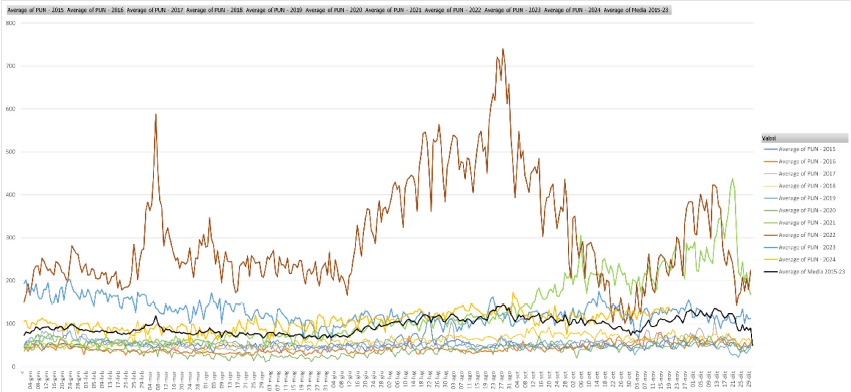
The year 2023, in blue, readjusted to more stable values, while remaining at a much higher average than the pre-pandemic situation. It was interesting to note how the energy price trend of 2024 is generally very similar to the average of the years 2015-2023, providing a relatively small margin of difference if used in an economic sustainability study for a project investment concerning RECs
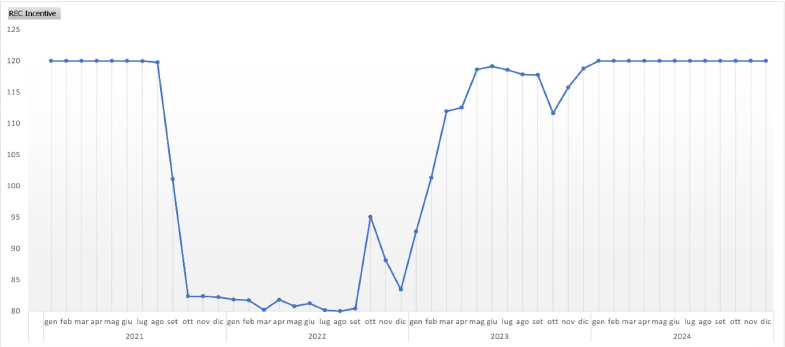
For this reason, in the results analysis, a comparison of the REC incentives calculated with an average PZ (black line) and with a PZ referring to 2022 has been studied, in the knowledge that pandemic or geopolitical events such as those that occurred can always recur in the future. Following the formula for small-scale plants described in Table 2, Figure 6 shows the development during the pandemic period of the average incentive per RECs. The incentive varies between 80 and 120 EUR/MWh, reaching a minimum when the PZ exceeds 180 EUR/MWh. This situation has occurred in the last months of 2021 and several months of 2022. At the beginning of 2023, the PUN began to fall back to average values, and the incentive rose again towards 120 EUR/MWh.
RECs incentive variation between 2021 and 2024 for small-scale plants using. Data elaborated from the “Results” section, PUN, of GME [29]
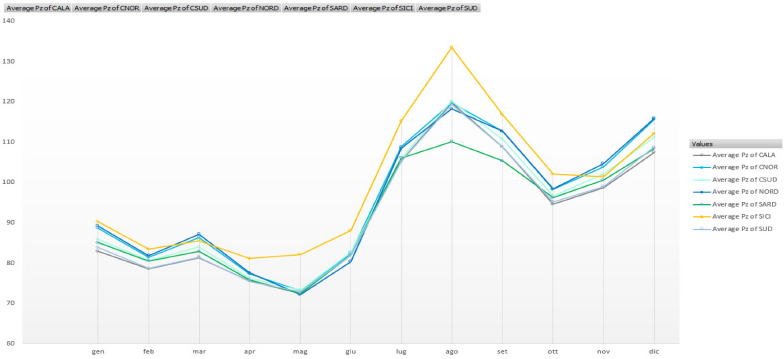
In Figure 7, the average hourly zonal price calculated from 2015 to 2023 is presented for all the different market zones. The values and trends throughout the year are similar across all zones, with a peak during the summer months. However, Sicily shows deviations both in the spring and summer periods, with a peak in August. Meanwhile, Sardinia maintains a lower price during the summer. The relative differences in PZ confirm the use of the PUN in the analysis.
Average Zonal Price variations for different market zones, between the years 2015 and 2023. Data elaborated from the “Results” section, Zonal Prices, of GME [29]. The color coding follows the scheme used by TERNA in Figure 1 of Annex 1 of the Technical Operating Provisions [26], based on the areas of the Italian electricity grid, which correspond to the Market Zones, as specified in the map presented and outlined in Table 4
To obtain reliable consumption data for standard domestic users, two key sources are typically referred to in Italy: ARERA [30] and GSE [31]. Both organizations provide critical datasets and analyses, each with its own role in the Italian energy market. The data they provide is essential for understanding domestic energy consumption patterns, which is important for energy policy development, market analysis, and the creation of tailored services.
ARERA provides two types of aggregate data regarding average electricity consumption:
• the average monthly electricity consumption, in kWh, recorded for all domestic customers together with the distribution of consumption by bands, in %, with reference to domestic customers treated by bands.
• the average hourly electricity consumption, in kWh, recorded for domestic customers treated hourly,
which are processed from:
• the aggregate withdrawals made available by the Integrated Information System (SII) based on the validated measurement data of each withdrawal point, transmitted by the distribution companies to transport users, via the SII itself;
• the total number of domestic customers in the electricity sector in Italy, broken down by geographical area (region or province), for which some data considered outliers have been purified. Prosumers are included, for which the data is not net of input, considering the customer's overall consumption.
The Free Market and Protected Market represent two distinct approaches to energy market regulation in Italy. While the Free-Market fosters competition and offers consumers the opportunity to choose their suppliers, it also exposes them to price volatility and complex decisions. On the other hand, the Protected Market offers a regulated, stable pricing environment that serves to protect vulnerable consumers but limits choice.
In the detailed extractable data, the average monthly consumption, as well as the percentage of average monthly consumption by each band at both the regional and provincial levels was included. This level of granularity allowed us to more precisely define the types of consumers we wish to simulate or analyze in comparable case studies under examination.
An overview of all the input parameters that can be selected for different scenarios simulation in the Italian context ae reported in Table 5.
Energy consumption input parameters
Parameter |
Input |
|---|---|
Year of data Electricity market’s type Contractual power (kVA) Type of user Region |
2021, 2022 Protected market, Free market, All markets Power capacity between 0 and 1,5, Power capacity between 1,5 and 3, Power capacity between 3 and 4,5, Power capacity between 3 and 4,5, Power capacity over 6 Resident, Non-Resident, All users Valle D’Aosta, Piemonte, Liguria, Lombardia, Trentino-Alto Adige, Veneto, Friuli-Venezia Giulia, Emilia-Romagna, Toscana, Marche, Umbria, Lazio, Abruzzo, Campania, Molise, Puglia, Basilicata, Calabria, Sicilia |
The costs considered for production systems were derived from the maximum thresholds defined by the GSE for the National Recovery and Resilience Plan (PNRR) contribution to photovoltaic systems [31]. Specifically:
1,500 EUR/kW for systems up to 20 kW;
1,200 EUR/kW for systems with a capacity exceeding 20 kW and up to 200 kW;
1,100 EUR/kW for systems with a capacity exceeding 200 kW and up to 600 kW;
1,050 EUR/kW for systems with a capacity exceeding 600 kW and up to 1,000 kW.
For the Operative Costs (OPEX) we used the technical assumptions accounted for in PV investment cost calculation and the financial modelling of technical risks in PV projects present in Solar Bankability [32].
An overview of all the parameters defined for the case studies used in the comparative analysis is provided in Table 6. The locations of Milan, Rome, and Catania, representing the regions of Lombardy, Lazio, and Sicily respectively, were chosen as representative for the comparison.
Case studies overview
Location |
Market zone |
FC Zonal (EUR/ MWh) |
Plant size |
Consumer type |
|---|---|---|---|---|
Lombardia (Milan) |
NORD |
+ 10 |
≤ 200 kWP 200 kWP < x ≤ 600 kWP > 600 kWP |
All residential domestic users between 3 and 4,5 kVA contract peak power |
Lazio (Rome) |
CSUD |
+4 |
||
Sicily (Catania) |
SICI |
+0 |
The cities of Rome, Milan, and Catania were selected for this study because they represent distinct extremes in Italy's energy market landscape. Rome and Milan, located in the central and northern parts of the country, experience different climatic conditions and energy consumption patterns compared to Catania, situated in the southern part. While all market zones have similar trends in energy generation potential, Sicily stands out due to its specific climatic conditions, as shown in Table 4 and Figure 7.
Targeting only domestic residential users, particularly those in the protected and free market segments, allowed for a more focused and reliable assessment of energy consumption patterns. This approach not only simplified the data analysis but also aligned with the broader policy objectives of economic, environmental, and social sustainability at the local levels. By focusing on both market segments, the analysis was able to capture the broadest possible range of residential energy users. Considering the protected market is significant because it ensures that even those with less financial flexibility have access to fair pricing, while the free market offers a more competitive pricing structure, which is crucial for households looking to optimize their energy costs.
The limitation of users with contractual power between 3 kW and 4.5 kW is significant, as this range represents the most common size of installations for urban residential consumers in these cities. Typically, consumers within this range are urban residents who benefit from residential energy incentives provided by the government, such as tax breaks and subsidies.
Urban areas like Rome, Milan, and Catania feature high population densities, which affect the potential for RECs formation and the adoption of photovoltaic systems, limiting the availability of space for traditional PV installations, necessitating innovative solutions and increased opportunities of pooling resources.
On the regional initiatives side, Sicily, Lazio, and Lombardy are among Italy's leading regions in promoting RECs. Each has adopted unique approaches, reflecting their regional priorities, economic conditions, and environmental needs serving as ideal case studies for comparing the impacts of renewable energy policies and self-consumption incentives. Sicily focuses on supporting energy self-sufficiency in rural and disadvantaged areas and addressing grid connectivity challenges, prioritizing funding for small municipalities to form RECs and integrating renewable energy with agriculture. Lazio concentrates on urban energy transition, particularly in Rome, through retrofitting buildings with renewable systems and fostering public-private partnerships while Lombardy emphasizes industrial and technological integration by supporting renewable energy adoption in industrial zones and incentivizing advanced technologies like smart grids and energy storage.
The results are presented for three different geographical areas in the following order:
1. A breakdown of the three national incentives, using both average prices from 2015 to 2023 and prices from 2022 under the high price scenario;
2. An evaluation of the percentage of energy sharing, focusing on strategies to maximize incentives;
3. A comparison between the old and new Italian REC Decree, examining changes in the regulatory framework introduced by the new decree relative to the previous one.
This comparison leveraged data from earlier calculation steps to highlight key differences and their impact on ECs, aiming to evaluate how the updated decree and the yearly variations of the energy market may influence economic and operational outcomes while aligning with policy goals.
A size-site combination (Milan-100 kW plant) has been depicted in Figure 8 in order to include in the discussion the case where the REC is the owner of a community plant and therefore receives both the TIP and the incentives for the sale and distribution of energy to the grid (RID and ARERA tariff). The same configuration is considered in the case of average hourly zonal prices and extreme zonal prices, i.e. relative to the pandemic period (2022). If in 2022, as the zonal price increases, TIP decreases, it should also be noted that the total resulting from the sum of the three incentives increases from 34.152 EUR to 61.032 EUR. Being the owner of the community plant therefore means ensuring resilience in the case of unforeseeable events.
Comparison between total REC remuneration (TIP + RID + ARERA incentives) in Milan and for a 100 kW PV plant
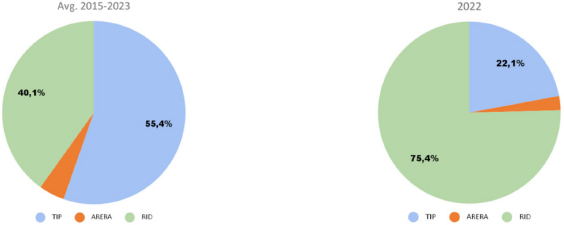
In Table 7 can be observed that, in the event of a significant increase in energy prices, the percentage of the RID contribution to the total rises more sharply for larger-scale installations. This highlights that, despite the new incentive system being designed to balance differences in local photovoltaic potential and account for energy price fluctuations - favoring smaller-scale installations - those in the 600 to 1000 kWP range demonstrate greater resilience to increases in the PUN Such resilience could be an advantage in the current context, where twenty-year energy price projections do not provide sufficient certainty for stable assessments.
National Incentives breakdown (TIP + RID + ARERA): a comparison between an average zonal price (Avg. 2015-2023) and a high-price scenario (2022)
Avg. 2015-2023 |
|||||
|---|---|---|---|---|---|
Location |
Systems size |
TIP |
ARERA |
RID |
TOTAL |
Milan (Lombardia) |
100 500 1000 |
55,36% 55,37% 51,20% |
4,51% 4,71% 4,93% |
4,51% 4,71% 4,93% |
34.152,05 € 163.472,77 € 312.370,53 € |
Rome (Lazio) |
100 500 1000 |
55,36% 55,37% 51,20% |
4,51% 4,71% 4,93% |
4,51% 4,71% 4,93% |
35.377,31 € 168.984,48 € 322.164,81 € |
Catania (Sicily) |
100 500 1000 |
55,36% 55,37% 51,20% |
4,51% 4,71% 4,93% |
4,51% 4,71% 4,93% |
36.927,97 € 176.327,48 € 336.030,24 € |
2022 |
|||||
Milan (Lombardia) |
100 500 1000 |
22,06% 20,15% 16,26% |
2,53% 2,59% 2,71% |
75,41% 77,26% 81,02% |
61.032,42 € 297.874,61 € 568.056,72 € |
Rome (Lazio) |
100 500 1000 |
22,33% 20,29% 18,14% |
2,70% 2,77% 2,85% |
74,97% 76,94% 79,01% |
61.844,33 € 301.319,60 € 586.835,04 € |
Catania (Sicily) |
100 500 1000 |
22,15% 20,05% 17,83% |
2,78% 2,86% 2,94% |
75,06% 77,09% 79,23% |
63.226,76 € 307.821,43 € 599.018,13 € |
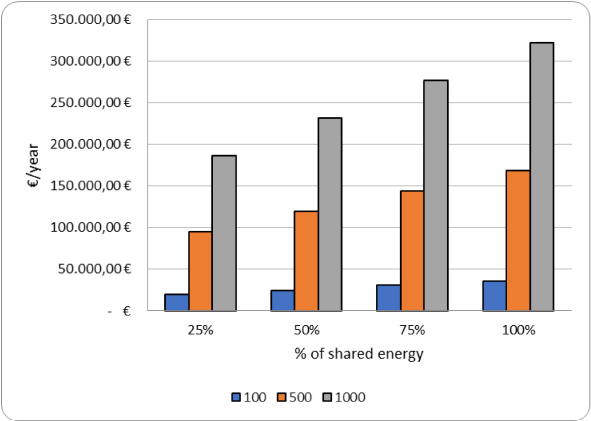
The relationship between the percentage of shared energy and the resulting REC cash flows for three different sizes (100 kW, 500 kW, and 1 MW) in Rome is illustrated in Figure 9. With the increase of shared energy from 25% to 100%, a consistent rise in total cash flows across all plant sizes and locations is registered. Among the three different geographical zones, the highest cash flows are consistently exhibited by Catania, followed by Rome and Milan, reflecting regional differences in solar potential and market conditions. Overall, the substantial financial benefits of maximizing the percentage of shared energy, particularly for larger photovoltaic systems, are underscored by the results.
Comparison between percentage of shared energy and total cash flows for Rome
The old Italian REC Decree (199/2021) and the new Decree (414/2023) are compared in Figure 10, highlighting the regional differences and overall changes in incentive structures and the reduction in the disparity between southern and northern regions under the new decree. Under the old decree, the tariff incentive for the South/North scenario showed a significant gap, with southern regions benefiting from much higher incentives, as evidenced by the 14% difference. In contrast, this gap has been considerably narrowed by the new decree, reducing the relative advantage of the South to less than 6%, particularly for scenarios like South/North and South/Centre. As shown, the analysis was again conducted for three different plant sizes, 100, 500 and 1000 kWp (due to the constraints explained in Table 2).
Comparison between old and new Italian REC Decree
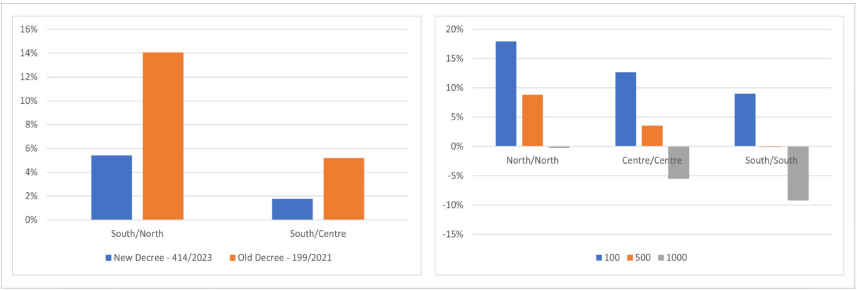
A broader trend is underlined: the general reduction in premium incentives for larger plants (1 MW), particularly in the southern region. This is especially evident in the South/South scenario, where the incentives under the new decree drop dramatically compared to the old decree, showing negative percentage changes for larger systems. For instance, the data for Catania clearly reflects this shift, with the highest reductions observed for large-scale plants, while smaller systems (100 kW) maintain relatively better performance. Two size-site combinations experience no change in the regulatory framework shift: the northern larger-scale plants and the central medium-size plants. Overall, the results suggest a shift toward a more balanced national incentive structure but at the cost of reduced financial support for southern regions, particularly for large-scale photovoltaic systems.
The present work employed a comparative methodology, to assess the impact of Italy's regulatory evolution for Renewable Energy Communities (RECs). By examining incentives under the previous Decree (199/2021) and the revised Decree (414/2023), the study analyzed changes in the distribution and magnitude of incentives across regions and plant sizes. Scenario simulations incorporated diverse variables, including zonal energy prices, plant capacities, and energy-sharing percentages, allowing a nuanced evaluation of both regional and national impacts. Historical price comparisons (2015–2023) and specific cases like pandemic-era energy prices provided additional insights into market-dependent variations in cash flows.
The results revealed significant shifts under the new decree, particularly in regional incentive equity. The historical advantage of southern regions, which previously benefited from 14% higher incentives due to superior solar resources, has been reduced to less than 6%. While this adjustment aims to promote national equity, it has led to a notable decrease in overall incentive levels for southern regions, particularly for larger photovoltaic systems (e.g., 1 MW installations in Catania). This reduction raises concerns about the strategic alignment of policies with regional renewable energy potential, potentially diminishing the attractiveness of large-scale solar investments in the South, where solar resources are abundant. In addition, the economic and quality-of-life gap that exists between North and South in the Italian peninsula should be leveled out, also benefiting the southern regions, which in this way risk instead being left behind or at best treated in the same way.
Scenario analyses further underscored the importance of shared energy within RECs, showing that higher percentages of shared energy correlate with increased cash flows. However, under high energy price conditions (e.g., during the pandemic), the incentive structure tended to favor individual prosumers, reducing the collective financial benefits for the community. This highlighted the resilience of energy communities that own their plants, which proved more capable of sustaining equitable benefits during market fluctuations.
The findings suggest that the new decree aligns with a vision of balanced, community-focused energy transitions, emphasizing smaller-scale installations and shared energy solutions. However, the reduction in southern incentives raises critical questions about the long-term regional development of renewable infrastructure in areas with the highest solar potential. These conclusions highlight the need for carefully calibrated policy tools that balance national equity objectives with the advantages of regional renewable resources. Future research could further explore the implications of such policies on the distribution and size of RECs, offering valuable guidance for other European nations designing their national incentive schemes.
The research has been co-founded by the Italian Ministry of Research through the HERA (Prot. 2022P7HAJF, CUP. E53D23003580006) “Holistic Energy Recovery Agent tool for sustainable urban clusters” project, within the PRIN 2022 program
- ,
“Mainstreaming Community Energy: Is the Renewable Energy Directive a Driver for Renewable Energy Communities in Germany and Italy?,” ,Sustainability (Switzerland) , Vol. vol. 14 (no. 12), 2022, https://doi.org/10.3390/su14127181 - ,
“Directive (EU) 2018/2001 of the European Parliament and of the Council of 11 December 2018 on the promotion of the use of energy from renewable sources,” , 2018 - ,
“How national policies influence energy community development across Europe? A review on societal, technical, and economical factors,” ,Energy Conversion and Management: X , Vol. vol. 23 , :1006242024, https://doi.org/10.1016/J.ECMX.2024.100624, p - ,
“Transposition of european guidelines for energy communities into austrian law: A comparison and discussion of issues and positive aspects,” ,Energies (Basel) , Vol. vol. 14 (no. 13), 2021, https://doi.org/10.3390/en14133922 - ,
“Solar collective self-consumption: Economic analysis of a policy mix,” ,Ecological Economics , Vol. vol. 199 , :1074802022, https://doi.org/10.1016/J.ECOLECON.2022.107480, p - ,
“Optimal design of renewable energy communities (RECs) in Italy: Influence of composition, market signals, buildings, location, and incentives,” ,Electric Power Systems Research , Vol. vol. 235 , :1108952024, https://doi.org/10.1016/J.EPSR.2024.110895, p - ,
“Mixed-integer linear programming based optimization strategies for renewable energy communities,” ,Energy , Vol. vol. 237 , :1215592021, https://doi.org/10.1016/J.ENERGY.2021.121559, p - ,
“Optimizing virtual energy sharing in renewable energy communities of residential users for incentives maximization,” ,Sustainable Energy, Grids and Networks , Vol. vol. 39 , :1014922024, https://doi.org/10.1016/J.SEGAN.2024.101492, p - ,
“Optimal Sizing of Renewable Energy Communities: A Multiple Swarms Multi-Objective Particle Swarm Optimization Approach,” ,Energies (Basel) , Vol. vol. 16 (no. 21), 2023, https://doi.org/10.3390/en16217227 - ,
“Multi-agent based energy community cost optimization considering high electric vehicles penetration,” ,Sustainable Energy Technologies and Assessments , Vol. vol. 59 , :1034022023, https://doi.org/10.1016/J.SETA.2023.103402, p - ,
“Optimal sizing of energy communities with fair revenue sharing and exit clauses: Value, role and business model of aggregators and users,” ,Appl Energy , Vol. vol. 299 , :1173282021, https://doi.org/10.1016/J.APENERGY.2021.117328, p - ,
“Financial Optimization of Renewable Energy Communities Through Optimal Allocation of Locally Generated Electricity,” ,IEEE Access , Vol. vol. 10 , :77571-775862022, https://doi.org/10.1109/ACCESS.2022.3191804, pp - ,
“Optimization of energy communities in the Italian incentive system,” ,in 2022 IEEE PES Innovative Smart Grid Technologies Conference Europe (ISGT-Europe) , 1-52022, https://doi.org/10.1109/ISGT-Europe54678.2022.9960513, pp - ,
“Optimization and Redistribution Strategies for Italian Renewable Energy Communities,” ,in IEEE EUROCON 2023 - 20th International Conference on Smart Technologies , 263-2682023, https://doi.org/10.1109/EUROCON56442.2023.10199011, pp - ,
“Renewable Energy Communities: Optimal sizing and distribution grid impact of photo-voltaics and battery storage,” ,Appl Energy , Vol. vol. 301 , :1174082021, https://doi.org/10.1016/J.APENERGY.2021.117408, p - ,
“From investment optimization to fair benefit distribution in renewable energy community modelling,” ,Appl Energy , Vol. vol. 310 , :1184472022, https://doi.org/10.1016/j.apenergy.2021.118447, p - ,
“Optimal Allocation Method for a Fair Distribution of the Benefits in an Energy Community,” ,Solar RRL , Vol. vol. 6 (no. 5), 2022, https://doi.org/10.1002/solr.202100473 - ,
“Impact of different regulatory approaches in renewable energy communities: A quantitative comparison of european implementations,” ,Energy Policy , Vol. vol. 195 , :1143992024, https://doi.org/10.1016/J.ENPOL.2024.114399, p - ,
“Renewable Energy Communities business models under the 2020 Italian regulation,” ,J Clean Prod , Vol. vol. 316 , :1282172021, https://doi.org/10.1016/j.jclepro.2021.128217, p - ,
“Economic benefits of Renewable energy communities in smart districts: A comparative analysis of incentive schemes for NZEBs,” ,Energy Build , Vol. vol. 305 , :1139112024, https://doi.org/10.1016/J.ENBUILD.2024.113911, p - ,
“Energy Communities Design Optimization in the Italian Framework,” ,Applied Sciences , Vol. vol. 11 (no. 11), :52182021, https://doi.org/10.3390/app11115218, p - ,
“Energetic and Economic Performances of the Energy Community of Magliano Alpi after One Year of Piloting,” ,Energies , Vol. vol. 15 (no. 19), :74392022, https://doi.org/10.3390/en15197439, Baselp - ,
“Designing aggregation criteria for end-users integration in energy communities: Energy and economic optimisation based on hybrid neural networks models,” ,Appl Energy , Vol. vol. 371 , :1235432024, https://doi.org/10.1016/J.APENERGY.2024.123543, p - ,
“Decree n.199 2021” , https://www.mase.gov.it/sites/default/files/Decreto%20CER.pdf - ,
“Italian Atlas of Solar Radiation” (In Italian, “Atlante italiano della radiazione solare.”) , , http://www.solaritaly.enea.it [Accessed Dec. 09, 2024] - ,
“Capacity Market”, (In Italian, “Mercato della Capacità”) , https://download.terna.it/terna/CM_DTF2_allegato2022_8d73227d2ed7fdd.pdf - ,
, , https://www.renewables.ninja [Accessed Dec. 09, 2024] - ,
“MERRA: NASA’s modern-era retrospective analysis for research and applications,” ,J Clim , Vol. vol. 24 (no. 14), :3624-36482011, https://doi.org/10.1175/JCLI-D-11-00015.1, pp - ,
“Single National Price”, (In Italian, “Prezzo Unico Nazionale”) , https://www.mercatoelettrico.org/it-it/Home/Esiti/Elettricita/MGP/Esiti/PUN - ,
“Analysis of domestic customer consumption”, (In Italian, “Analisi dei consumi dei clienti domestici”) , , https://www.arera.it/dati-e-statistiche/dettaglio/analisi-dei-consumi-dei-clienti-domestici [Accessed Dec. 09, 2024] - ,
“Energy Communities page.” , , https://www.gse.it/servizi-per-te/autoconsumo/gruppi-di-autoconsumatori-e-comunita-di-energia-rinnovabile/comunit%C3%A0-energetiche-rinnovabili [Accessed Dec. 09, 2024]